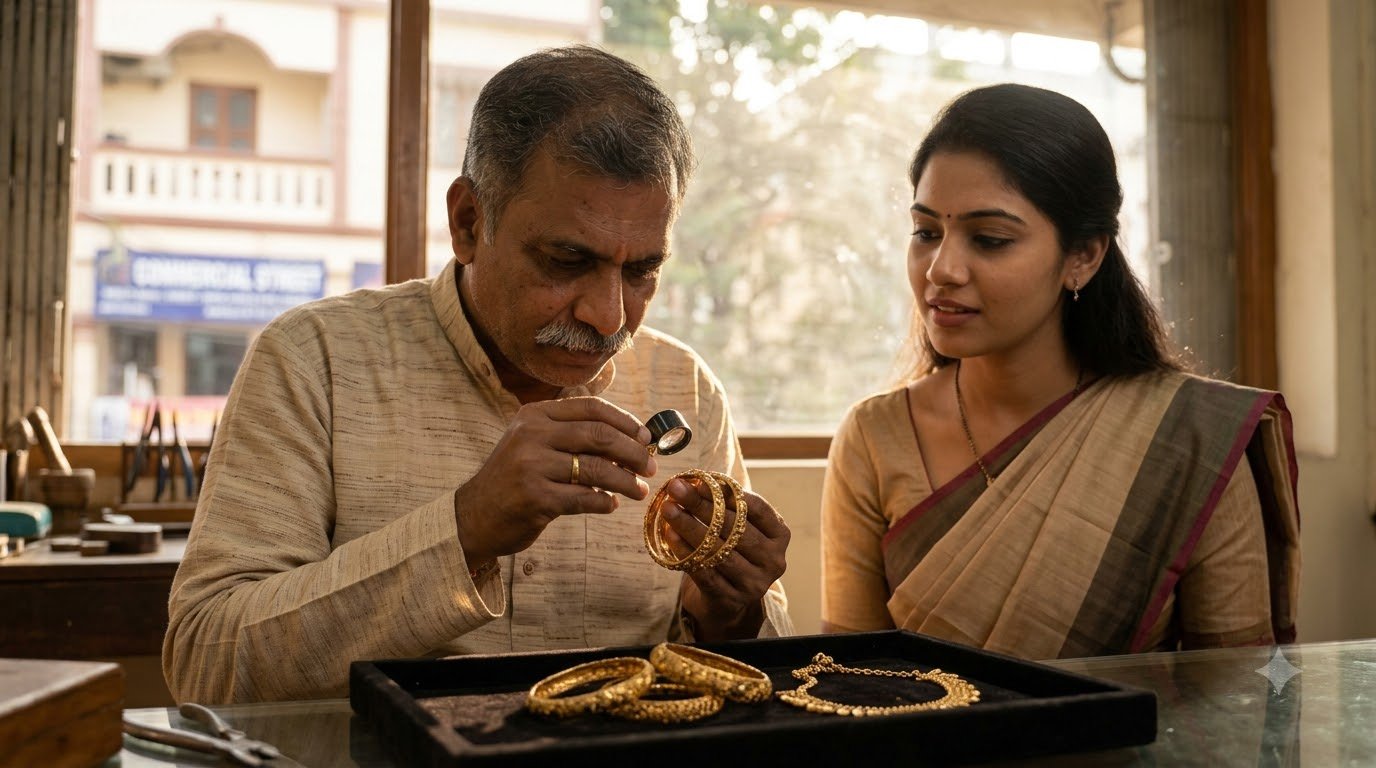
Two people can bring in the exact same gold, on the same day, and still walk away with different payouts — because gold valuation isn't guesswork, it's maths. Someone who knows how the price is calculated can check a quote in seconds. Someone who doesn't has to just trust the number they're given. Once you know the three numbers behind every valuation, you'll always be the one who understands it.
The Formula Every Gold Buyer Is Actually Using
Strip away the sales talk, and every fair valuation comes down to this:
No hidden variables, no "special" factors — just three numbers multiplied together. Let's break down each one, because this is exactly where payouts quietly go up or down.
Purity — the Number That Changes Everything
Gold jewellery is almost never 100% gold. It's mixed with metals like copper, silver, or zinc for strength, which is why 22K, 18K, and 14K pieces can look nearly identical but be worth noticeably different amounts.
| Purity | Gold Content | Common Use |
|---|---|---|
| 24K | 99.9% | Rarely used in jewellery (too soft) |
| 22K | ~91.6% | Most common for Indian jewellery |
| 18K | 75% | Stone/diamond-studded pieces |
| 14K | 58.3% | Lighter, everyday pieces |
You can't reliably eyeball purity, and an old hallmark stamp doesn't always reflect a piece's current condition — years of repairs, soldering, or re-plating can shift it. This is why purity needs to be tested, not assumed. A proper XRF (X-ray fluorescence) test reads the exact metal composition in a couple of minutes — no melting, no scratching, nothing done to your jewellery that you can't watch happen in front of you.
Weight — But the Right Kind of Weight
This is the quiet detail that trips up a lot of first-time sellers. Jewellery weight comes in two flavours:
- Gross weight — the full piece, stones and all
- Net gold weight — just the gold, after subtracting stones or non-gold attachments
A fair valuation always works off net gold weight, not gross. If a buyer weighs your piece stones-and-all and calculates your payout on that number, you're being shortchanged on weight that isn't even gold. A ring with a heavy stone setting, for instance, can have its gross weight look impressive while its actual gold content is a fraction of that — which is exactly why the "net" figure is the one that matters.
Today's Live Rate
Gold prices move daily with global markets and demand — sometimes noticeably even within the same week, which is exactly why a one-time "fixed" quote should never be trusted at face value.
A trustworthy buyer quotes you against today's rate and is upfront that this rate fluctuates and is never a guaranteed number. If someone can't tell you today's rate before you agree to anything, that's worth pausing on.
Putting the Formula to Work
Here's how the three numbers come together in practice. Say you bring in a 22K gold chain weighing 10 grams gross, with no stones or attachments, so the net gold weight is also 10 grams. At 91.6% purity, that's 9.16 grams of actual gold. Multiply that by today's per-gram rate, and that's your payout — before any deductions. This is the exact calculation that should be shown to you, line by line, at the time of sale. If a buyer skips straight to a final number without walking you through these three steps, ask them to break it down.
The Wastage Deduction Trick to Watch Out For
Here's something worth knowing before you sell: some buyers apply a "wastage" or "making charge" deduction — typically 5–15% — when they buy old gold back from you, citing "processing" or "refining" costs.
That deduction makes sense in one context only: when a jeweller is making new jewellery for you, where craftsmanship genuinely has a cost. It has no place in a cash-for-gold transaction, where nothing is being crafted — just tested, weighed, and valued.
| Wastage Applied | No Wastage Applied | |
|---|---|---|
| What's happening | Buyer deducts 5–15% citing "processing" | Payout = weight × purity × rate, nothing extra |
| Where it belongs | Making new jewellery (craftsmanship cost) | Buying back old gold |
| What to ask | "What exactly is this deduction for?" | N/A — nothing to explain |
What a Fair Evaluation Looks Like
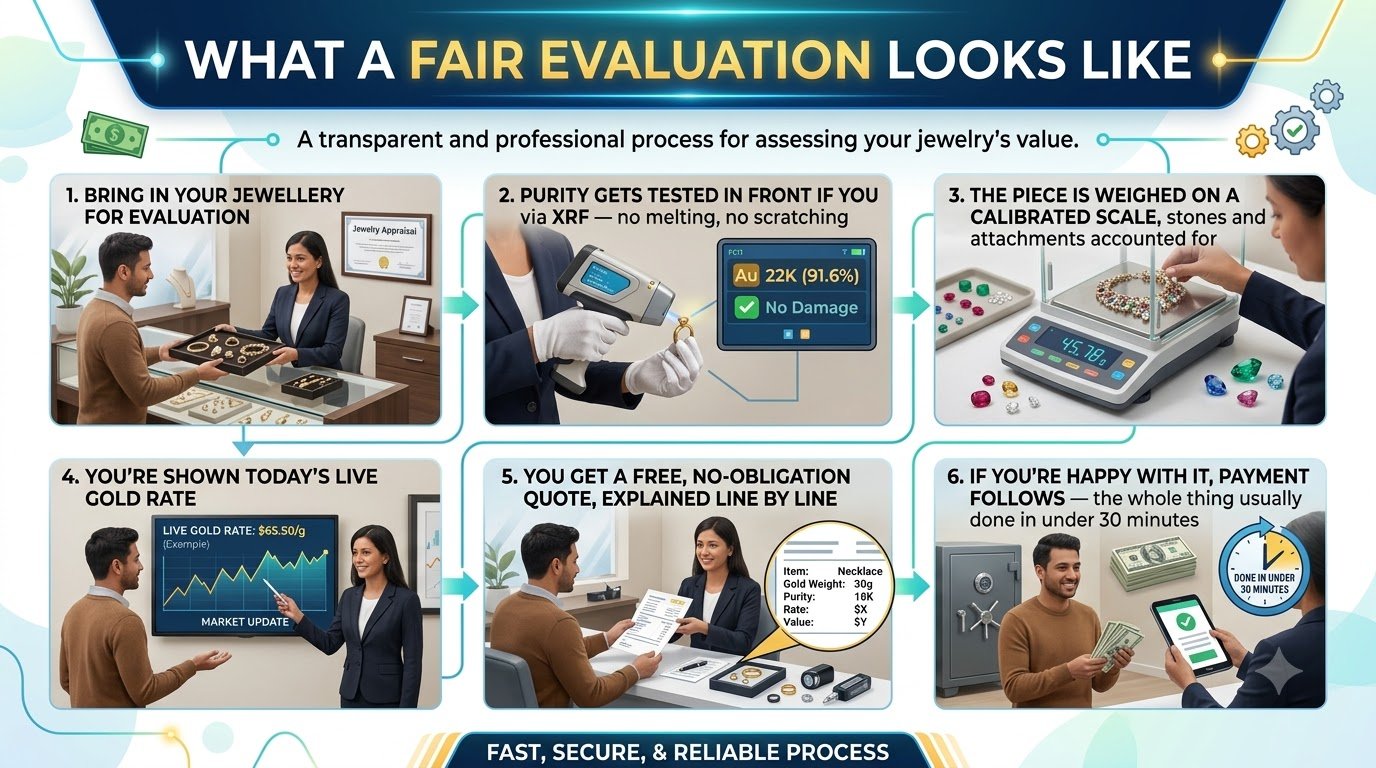
- Bring in your jewellery for evaluation
- Purity gets tested in front of you via XRF — no melting, no scratching
- The piece is weighed on a calibrated scale, stones and attachments accounted for
- You're shown today's live gold rate
- You get a free, no-obligation quote, explained line by line
- If you're happy with it, payment follows — the whole thing usually done in under 30 minutes
When every step is visible, you're not asked to just trust a number — you can watch it get calculated.
FAQs
Does the design or brand of the jewellery affect its gold value?
No. Cash-for-gold valuation is based purely on gold content — purity × net weight × rate — not the design, brand, or craftsmanship. Antique and modern pieces are valued the same way, gold-for-gold.
Why do two jewellers sometimes quote different prices for the same piece?
Almost always because of the maths, not the metal — one might be using gross weight instead of net weight, applying an unexplained wastage cut, or testing purity less accurately. Ask each buyer to show their purity result and calculation side by side.
Is XRF testing safe for my jewellery?
Yes. It's non-destructive — it reads metal composition using X-ray fluorescence, with no melting, scratching, or acid testing involved.
Do I need the original purchase bill to sell my gold?
It helps, but it isn't essential. Purity and weight are independently tested at the time of sale, regardless of when or where the piece was bought.
How long does the whole process usually take?
When purity testing, weighing, and quoting are done efficiently and transparently, the entire process — from walking in to walking out with payment — typically takes around 30 minutes.
Conclusion
Your gold's value isn't a mystery — it's three numbers multiplied together: net weight, tested purity, and today's rate. Know these, ask to see them calculated in front of you, and you'll always know whether a quote is fair.